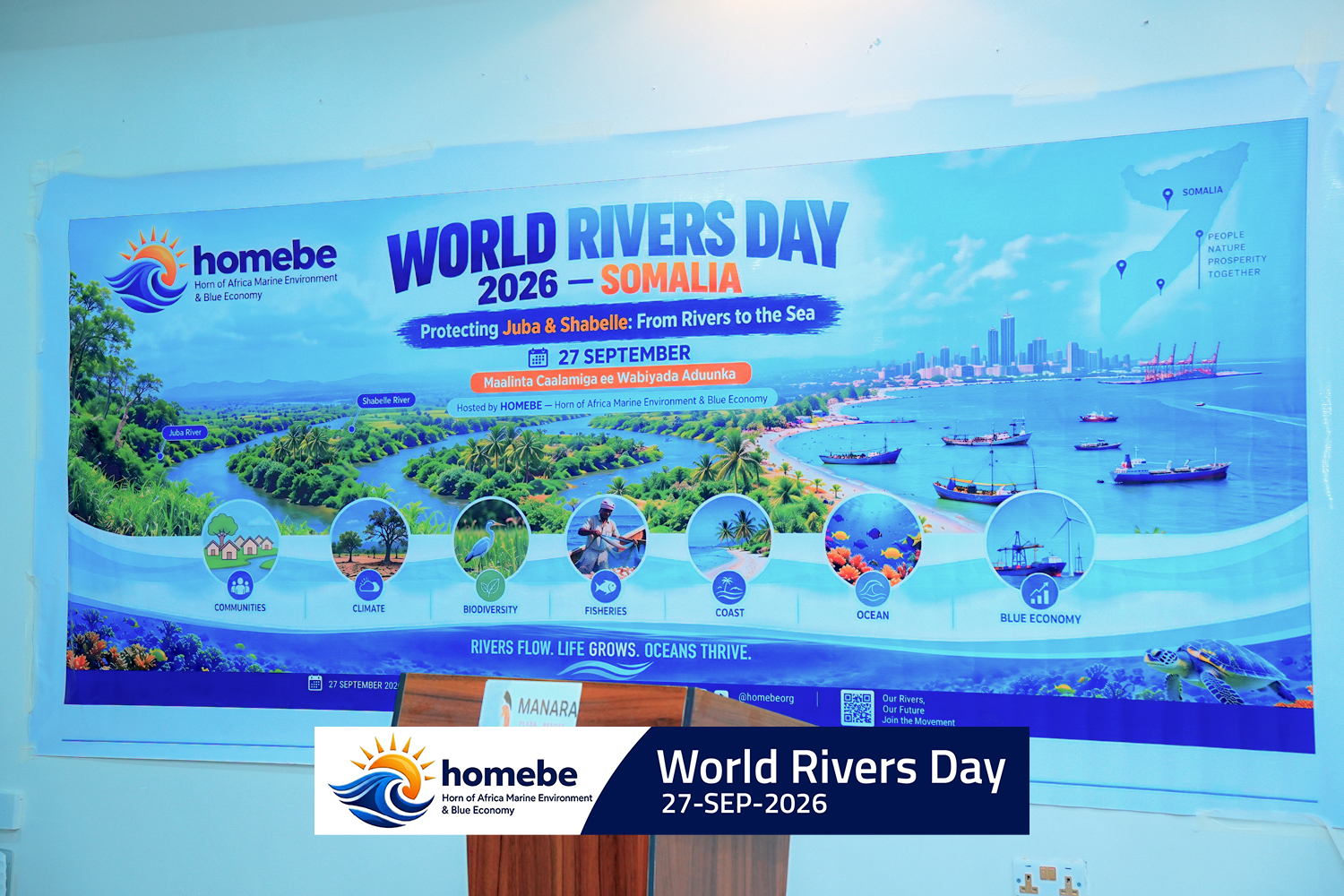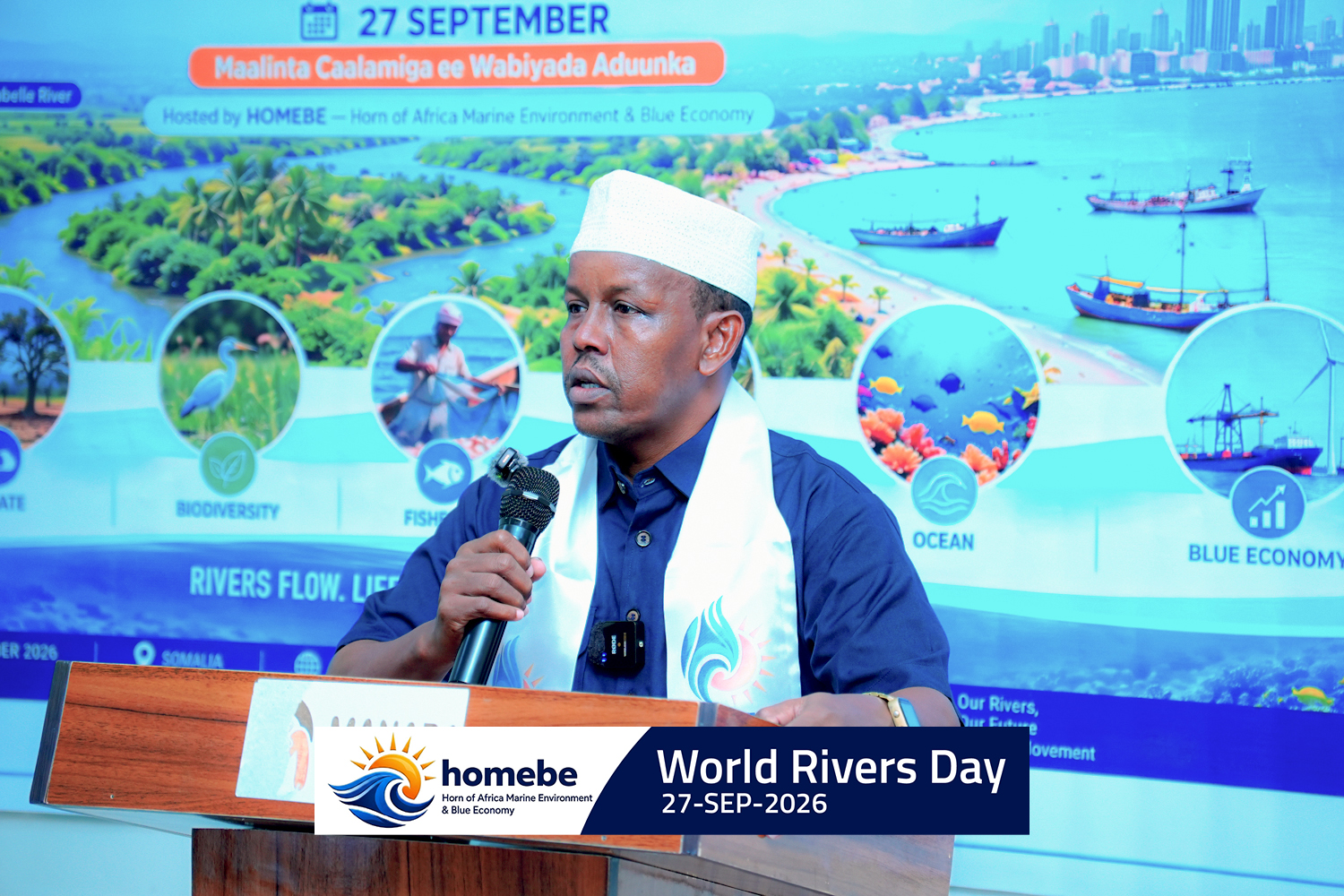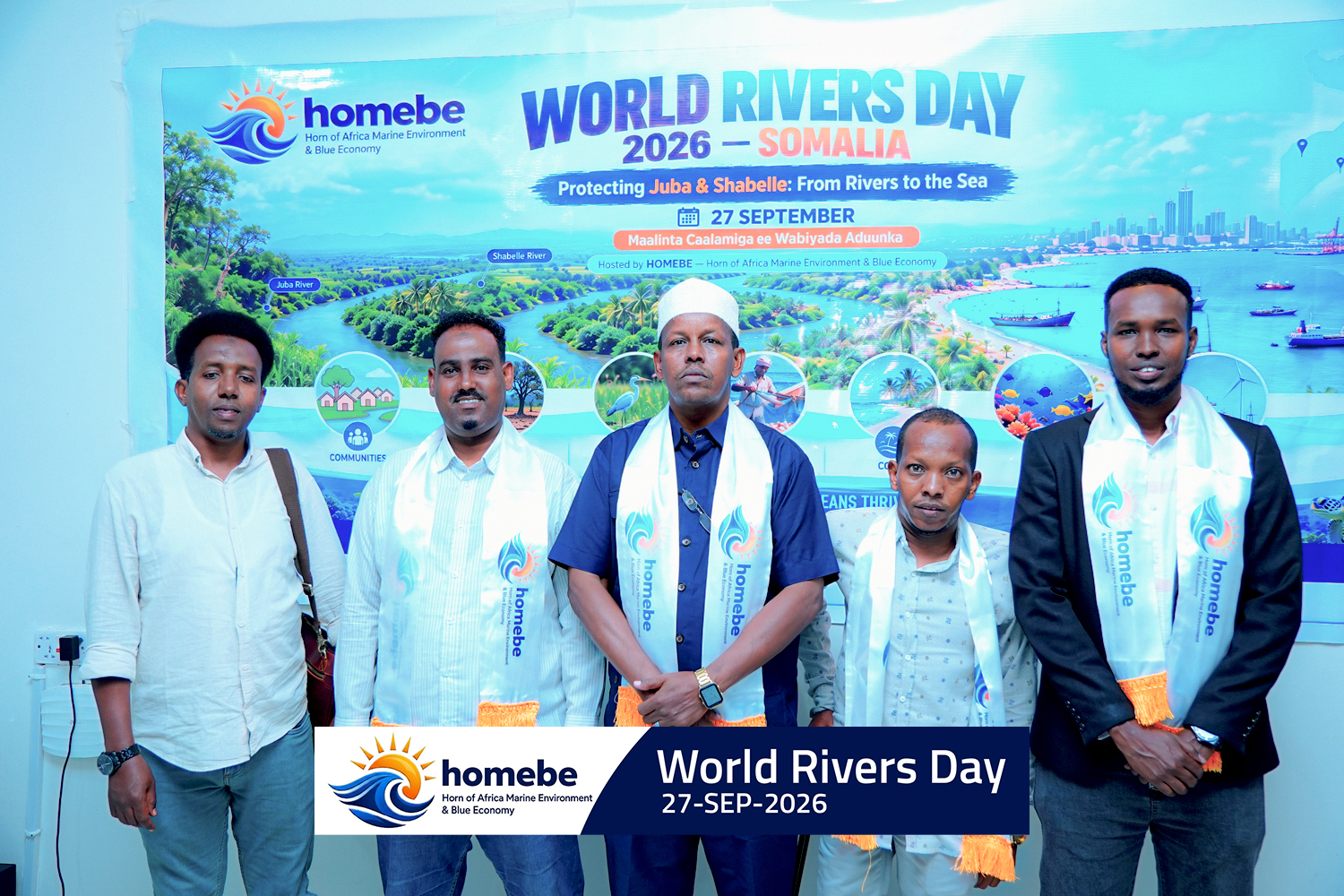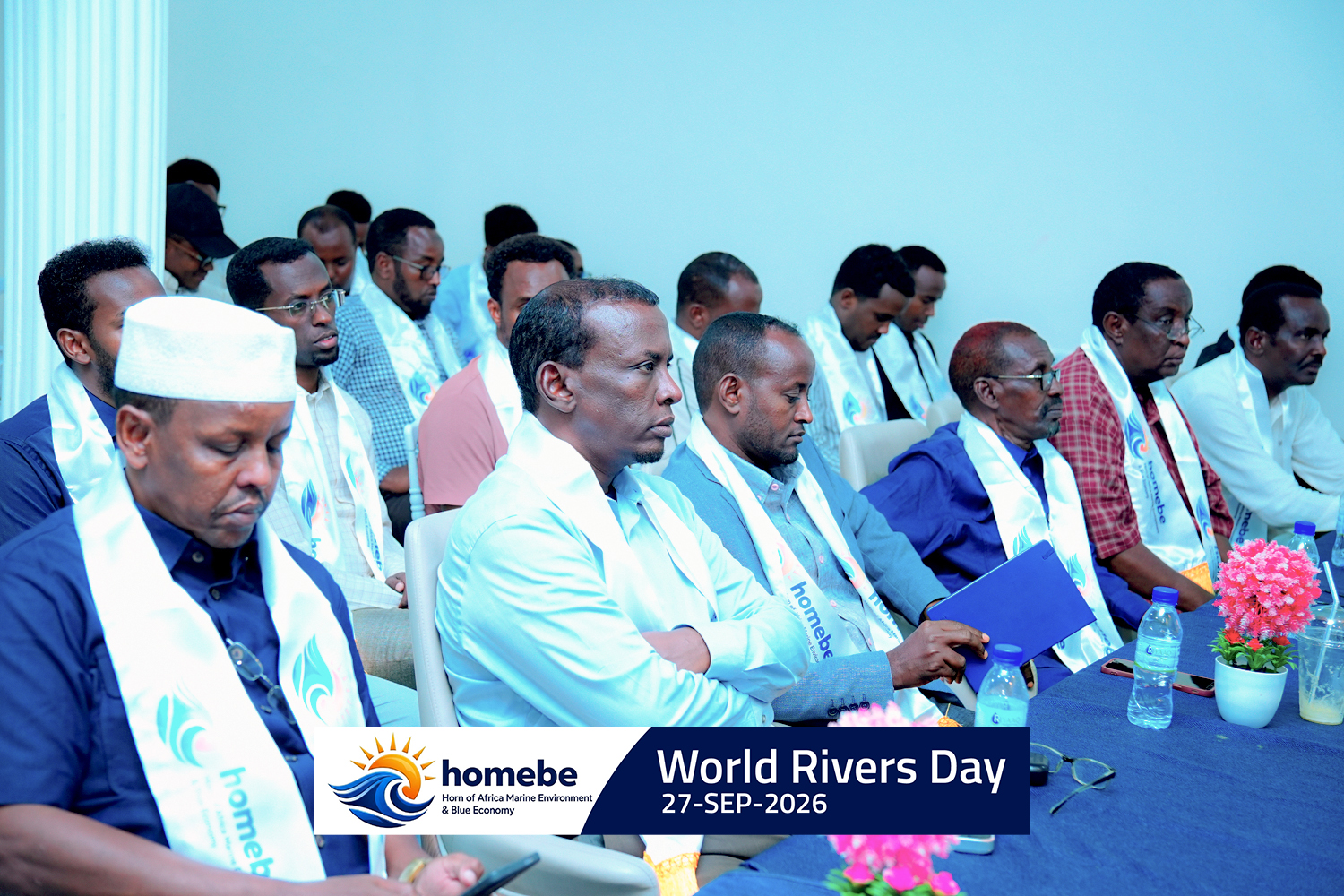
Protecting Juba and Shabelle from Rivers to the Sea Horn of Africa Marine Environment & Blue Economy (HOMEBE) Mogadishu Somalia | 27 September 2026 Report prepared 18 October 2026
Executive summary HOMEBE convened a World Rivers Day event in Mogadishu on 27 September 2026 to highlight the condition of Somalia’s rivers and their connection to the sea. Speakers raised concerns about pollution, siltation, recurring floods, dry-season shortages and irrigation management. Published reporting provid 1 Event overview Item Detail Organiser Horn of Africa Marine Environment & Blue Economy (HOMEBE) Occasion World Rivers Day, held every year on the fourth Sunday of September Date and place Sunday 27 September 2026, Mogadishu, Somalia Theme Protecting Juba & Shabelle: From Rivers to the Sea Participants Environmental experts and community members, many of them farmers who depend on the rivers and live in polluted areas Speakers named Abdisalan Mohamed HaGi, HOMEBE Chairman Organiser statement Organisers described this as the first event in Somalia dedicated to the condition of its rivers; 1.1 Event objectives The event centred on protecting the Juba and Shabelle rivers and explaining the connection between inland water management and coastal environmental health. The reported discussions addressed waste disposal, channel maintenance, flooding, irrigation and water availability. This report organises those messages into three practical purposes: understanding the pressures on the rivers, identifying the implications for people and livelihoods, and setting out actions for follow-up. The available record documents an awareness and advocacy event. It does not establish that participants adopted a formal declaration, endorsed a budget or assigned implementation responsibilities. The proposed programme below should therefore be treated as a basis for consultation. 2 Purpose and evidence base This report documents HOMEBE’s World Rivers Day event in Mogadishu on 27 September 2026. It brings together the event messages, relevant published evidence and proposed actions to protect the Juba and Shabelle rivers and the coastal environment. The report draws on event news coverage [9], photographs and the event banner supplied by HOMEBE, and the publications listed in Sources. HOMEBE’s river assessment was not available for review. Statements about its findings are therefore attributed to the speakers rather than presented as independently verified results. Recommendations and suggested responsibilities in this report are proposals for discussion; they were not recorded as decisions or commitments made at the event. 2.1 Approach to preparation Preparation involved reviewing the supplied event material, organising the two named speakers’ messages by topic, and relating those messages to the publications already cited in the source report. Event photographs are used to illustrate participation and the event setting. They do not establish attendance totals, participant identities or the technical findings of the river assessment. 2.2 How to interpret the evidence Three types of information appear in this report. Event statements describe what speakers reportedly said. Contextual evidence describes conditions or incidents reported in the cited publications, often in earlier years. Proposed actions reflect the report’s analysis of the issues and remain subject to institutional agreement. These categories should be kept separate when the report is used for advocacy, programme design or fundraising. The supporting bibliography has been retained from the supplied report. No new field observations, water-quality testing, engineering survey or independent verification of the underlying publications was undertaken for this editorial revision. Historical figures are included with their dates and should not be read as a current national baseline. 3 Background 3.1 World Rivers Day World Rivers Day was proposed by Mark Angelo, a Canadian river conservationist, and was first held in 2005, the year the United Nations launched its Water for Life Decade. It takes place on the fourth Sunday of September and aims to celebrate waterways, raise awareness of what rivers are worth and encourage better stewardship [1]. HOMEBE’s event brought that global observance to Mogadishu with a focus on Somalia’s own rivers. 3.2 The Juba and Shabelle rivers Somalia’s two permanent rivers both draw their water from Ethiopia. The Jubba begins at the Ethiopia–Somalia border, where the Dawa and Ganale Dorya rivers meet, and flows south past Luuq, Bardhere and Buale to the Indian Ocean near Kismayo [2]. The Shabelle flows southeast from Ethiopia towards Mogadishu, then turns southwest to run parallel to the coast. It usually dries out before reaching the Jubba and only joins it in years of heavy rain [3]. Farming along both rivers depends on irrigation. The Shabelle is central to Somalia’s agriculture, but decades of conflict and the collapse of state structures weakened the institutions and water infrastructure that manage it [10]. A 2019 survey in Lower Shabelle alone recorded 246.8 km of canals, and noted that functioning irrigation infrastructure was lacking [4]. This is why pollution, siltation, flooding and low flows are direct threats to food production and to riverside livelihoods. 3.3 Seasonal river conditions Season Months What it means for the rivers Jilaal Jan–Mar Harsh dry season. The Shabelle and Juba are likely to drop sharply, and parts of the Shabelle have dried out completely [7][11]. Gu’ Apr–Jun Main rainy season. Heavy rain raises river levels and can cause riverine and flash flooding [5]. Xagaa Jul–Sep Normally the drier months between the rains. The speaker said floods now sometimes occur even in Xagaa. Deyr Oct–Dec Second rainy season in southern and central Somalia [11]. The El Niño floods of late 2023 came in this season [6]. 4 Event proceedings 4.1 Programme and participation HOMEBE hosted the event in Mogadishu on Sunday 27 September 2026. The event banner connected river protection with communities, climate, biodiversity, fisheries, the coast, the ocean and the blue economy. Environmental experts and community members attended, including farmers who depend on the rivers [9]. An attendance total and a detailed programme were not available. 4.2 Key speaker messages Abdisalan Mohamed HaGi, HOMEBE Chairman, warned that waste dumped into rivers damages the rivers, affects nearby people and livestock, and carries pollution towards the sea. He said HOMEBE’s assessment found the rivers in poor condition and described increasing waste dumping in river towns. He called for stronger responsibility and systems for river protection and management [9]. a speaker at the event, highlighted siltation, limited dredging, recurring floods and dry-season water shortages. He linked these concerns to reduced channel capacity, deliberate riverbank breaches, the loss of seasonal storage and unplanned irrigation canals. These are the speaker’s reported observations [9]. The chairman described a connected pathway of harm from river pollution to nearby communities and livestock, and onward to the sea [9]. 5 Main issues and supporting evidence 5.1 Pollution and public health The event’s central concern was waste disposal into rivers. The chairman warned that pollution affects river ecosystems and the water used by people and livestock, with further consequences downstream and at sea [9]. Separately, Save the Children has warned that flooding, damaged infrastructure and poor sanitation in Beledweyne increase disease risks, including cholera and malaria [12]. Evidence limitation. The assessment’s methods, sampling locations and results were not available. The report therefore cannot quantify pollution levels or establish the extent of contamination. Publishing the assessment would support a measurable baseline for future monitoring. 5.2 Siltation and channel capacity A Speaker reported that dredging had not taken place for several years [9]. Subsequent news coverage of a SoDMA statement on 4 October 2026 also described heavy siltation and 366 major high-risk breach points on the Shabelle [8]. Earlier reporting quoted a SWALIM official as saying that regular maintenance stopped after 1991 [7]. These accounts indicate a persistent maintenance concern, although the extent of capacity loss requires technical assessment. 5.3 Recurring floods Mr Omar described floods as becoming more frequent, progressing from long intervals to annual or seasonal occurrences, including during Gu’, Deyr and sometimes Xagaa [9]. This account is a speaker’s observation, not a measured flood-frequency trend. Recent floods show the scale. In the 2023 Gu season the Shabelle burst its banks in Hiran, and the UN counted more than 450,000 people affected and about 22 deaths across 17 districts [5]. By mid-November 2023, El Niño rains along the Juba and Shabelle had pushed about 500,000 people from their homes [6]. Not all flooding is natural: Mr Omar said some follows deliberate bank breaches, and SoDMA reported a stretch between Jalalaqsi and Mahadaay where part of the river was filled in and turned into a road [8]. 5.4 Dry-season shortages and water storage Mr Omar linked dry-season shortages to the loss of a seasonal water-storage system. He referred to the Hawaadle Reservoir, saying it had stored surplus water for release when river levels fell. He described Saudi funding, construction by a Chinese company and a cost of USD 34 million. The reservoir’s identity, history, cost and current status require verification before they are used for investment planning. Dry-season failure is well documented. In February 2018 the Shabelle dried up completely in parts of Jowhar, the third time since March 2016 [7]. In 2019 the river was again dangerously low from January, after dry spells in 2016, 2017 and 2017–18 [13]. 5.5 Canal planning and irrigation management Mr Omar raised concerns about unplanned canals and unregulated water abstraction [9]. A 2019 FAO-supported initiative in Lower Shabelle planned to rehabilitate 246.8 km of canals serving 30,300 hectares and train water management committees [4]. This provides a documented example of the scale and management arrangements proposed for irrigation rehabilitation; it does not establish that all planned works were completed. 5.6 Institutional coordination The chairman called for clearer responsibility for river protection [9]. A Shabelle basin diagnostic and action plan prepared for GIZ with the Ministry of Energy and Water Resources between November 2020 and May 2022 addressed irrigation, flooding, livestock, governance and cross-border cooperation [10]. The 2019 FAO-supported project also referenced support for the Shabelle River Basin Authority [4]. These initiatives provide a basis for discussing roles, coordination and maintenance responsibilities; their current operational status should be confirmed. 5.7 Implications for river management The issues described are connected. Poorly managed waste can enter waterways; floods can spread contaminated water across settlements and fields; siltation and damaged banks can complicate flood management; and unplanned abstraction can intensify competition for water when flows are low. The event record does not quantify the contribution of each factor. A practical response should combine monitoring, maintenance, waste services and water-use planning rather than assume that one intervention will resolve every problem. Channel works require particular care. Desilting and bank repair should follow site-specific engineering and environmental review, including where excavated material will be placed and how works could affect downstream communities. Storage proposals should first establish the relevant asset, ownership, condition and feasibility. The available record is insufficient to endorse a particular construction or rehabilitation investment. 5.8 River to sea implications The event theme provides a useful framework for connecting river management with coastal protection. HOMEBE’s chairman described waste travelling downstream to the sea [9]. That concern supports coordination between river, waste-management and marine stakeholders. It does not, on the evidence available here, establish measured pollutant loads at river mouths or documented effects on particular marine species. Future assessment should make that distinction explicit. 6 People and livelihoods affected Group Impact Evidence Riverside residents Loss of drinking water when the river dries; displacement in floods; fear of cholera and malaria after flooding. Jowhar 2018 [7]; 2023 floods [6]; Beledweyne [12] Farmers Crops lost to drought and to floods. In 2019 a two-hectare farmer who had invested about $2,000 lost the crop, and a six-hectare farmer near Jowhar lost everything. Radio Ergo 2019 [13] Livestock owners Animals cannot drink when the river is dry; livestock were swept away in the 2023 Gu floods. Jowhar 2018 [7]; Gu 2023 [5] Fishers Hundreds of fishermen at Jowhar faced unemployment when the river dried. Marine life is threatened by waste carried to the sea. Jowhar 2018 [7]; HOMEBE Chairman [9] Towns and services Homes, schools, health facilities and roads damaged or closed in floods. Gu 2023 floods [5] 6.1 Jowhar case example In February 2018 the river dried up completely in parts of Jowhar. Residents who relied on it for drinking water, farmers who relied on it for irrigation, pastoralists and fishermen were all affected, across Jowhar and about 20 surrounding villages. Rainfall in the catchment had fallen from about 600 mm to no more than 200 mm over three years. The Hirshabelle regional parliament agreed to build wells and provide temporary water, but the regional government said it lacked the capacity and funding and asked NGOs and the federal government for help [7]. A year later farmers near Afgooye and Jowhar were again counting losses, and an agricultural expert said weather alerts were not reaching farmers well enough [13]. 6.2 Inclusion in follow-up activities Consultation should include farmers, livestock owners, fishers, residents of flood-prone settlements and people who depend on river water for household use. Women, young people, displaced households and people with disabilities should have accessible opportunities to contribute. These are proposed participation principles, not a description of the event’s verified attendance. Local engagement should identify where people obtain water, how alerts reach them, which waste services are available and what prevents safe canal operation or maintenance. A simple feedback channel would allow communities to report dumping, bank damage and water shortages. Reports should be checked before they inform enforcement or investment decisions. 6.3 Timeline of reported events When What happened Source Feb 2018 Shabelle dries up completely in parts of Jowhar, the third time since March 2016. Radio Ergo [7] Feb 2019 Low water again; farmers near Afgooye and Jowhar report lost crops. Radio Ergo [13] May 2023 Gu floods: Shabelle bursts its banks in Hiran; over 450,000 people affected. Down To Earth [5] Nov 2023 El Niño floods along the Juba and Shabelle; about 500,000 people leave their homes. UN Geneva [6] 27 Sep 2026 HOMEBE marks World Rivers Day in Mogadishu and warns of river pollution. Dawan Africa [9] 4 Oct 2026 SoDMA reports 366 major high-risk breach points on the Shabelle. Dawan Africa [8] 7 Risks and priorities The priorities below are qualitative judgments based on the material reviewed. They are intended to guide discussion and do not replace a technical risk assessment. Historical figures refer to the dates cited and should not be treated as current measurements. Risk Why it matters Indicative priority Flooding from breached banks SoDMA reportedly identified 366 high-risk breach points in October 2026 [8]; technical verification and prioritisation are needed. High Dry-season shortages Repeated dry-ups at Jowhar and Afgooye; storage plan reported lost [7][13]. High Disease after floods Damaged sanitation and flood water raise cholera and malaria risk [12]. High Insecurity limiting works SoDMA said insecurity along the river makes maintenance difficult [8]. High Pollution of rivers and sea Reported by HOMEBE; evidence not yet published. Medium to high Resources for implementation Proposed works and monitoring require cost estimates and confirmed funding; no implementation budget was available. To be assessed 8 Proposed actions The following actions respond to the issues raised at the event and in the supporting publications. Suggested leads and timeframes require agreement with the institutions concerned. # Action Suggested first steps Lead and horizon 1 Publish HOMEBE’s river assessment and monitor water quality. Release methods, sampling sites and results; agree a small set of regular test sites with the water and environment ministries. HOMEBE with ministries. Short term 2 Agree who is responsible for each river. Convene federal and state bodies, the Shabelle River Basin Authority and districts to confirm roles and reporting lines [4][10]. Federal and state governments. Short term 3 Stop waste dumping at river towns. Map dumping points; set up collection and disposal sites away from the banks; run community clean-up days. District councils, communities. Short to medium 4 Assess channel maintenance and repair priority riverbank breaches. Verify the reported breach inventory; assess channel conditions and prioritise repairs based on risk, feasibility and access [8]. SoDMA, state agencies, partners. Medium term 5 Plan and regulate canals and offtakes. Survey unplanned canals; extend the canal rehabilitation and water committee model used in Lower Shabelle [4]; discourage deliberate breaches. Agriculture and water authorities, farmer groups. Medium term 6 Assess seasonal water storage. Check the status and history of the Hawaadle Reservoir and options to restore storage and release in Jilaal. Water ministry, technical partners. Medium to long 7 Strengthen early warning and keep World Rivers Day. Share flood and drought alerts with farmers [13]; use pre-positioned boats and cash support as in 2023 [6]; report progress each September. HOMEBE, SoDMA, partners. Ongoing 8.1 Suggested implementation sequence Period Focus Next 3 months Publish the assessment; share this report with ministries, SoDMA and the Basin Authority; agree who leads on each river. 3 to 12 months Map dumping points and breach points; start waste collection pilots; survey canals and offtakes; check the Hawaadle Reservoir. 1 to 3 years Desilting and bank repair at priority points; regulated canals; restored storage if feasible; a second World Rivers Day report showing progress. 8.2 Immediate follow-up within three months HOMEBE could begin by assembling the event record and the underlying river assessment in one review package. The package should include the programme, available attendance records, assessment methods, sampling locations, findings, photographs and the limitations of the evidence. Any personal information in attendance records should be handled appropriately; public reporting can use aggregated participation figures. A technical follow-up meeting could then review the evidence and identify the institutions willing and authorised to lead each workstream. The immediate outputs should be a validated issue list, a record of agreed responsibilities, a short list of locations requiring assessment and a timetable for the next review. These are suggested outputs, not commitments already secured. 8.3 Pilot activities within three to twelve months Pilot locations should be selected using transparent criteria: the number of people exposed, dependence on river water, reported dumping or bank damage, access, local willingness to participate and the availability of responsible public agencies. A small number of feasible pilots would make it easier to establish operating arrangements and measure results before expansion. A waste-management pilot should map dumping points, identify a safe and authorised disposal route, and clarify who will collect waste after any clean-up campaign. A canal-management pilot should record offtakes, users and maintenance arrangements, then support a locally agreed operating plan. A flood-risk pilot should verify reported damage and connect community reporting with technical inspection and early warning. 8.4 Infrastructure decisions over one to three years Larger works should proceed only after feasibility studies, safeguards review, cost estimates and agreement on ownership and maintenance. Options may include targeted bank repair, technically justified desilting, canal rehabilitation and seasonal storage. Selection should consider downstream impacts and the ability to operate and maintain the asset after construction. Before seeking investment, each proposed project should define the problem, location, intended beneficiaries, evidence base, alternatives considered, expected results, capital and operating costs, access constraints and responsible institution. An investment case should not rely solely on the event statements or the unverified reservoir history. 8.5 Resourcing and implementation conditions No approved implementation budget or confirmed financing is documented in the available materials. A costed plan should distinguish coordination and assessment costs from recurring monitoring, waste services, maintenance and capital works. Funding discussions should follow the definition of activities and institutional responsibilities. Access and security may limit inspection and construction. Procurement lead times, seasonal river conditions and the availability of technical staff should also inform scheduling. Where access is constrained, partners should record what has and has not been inspected and avoid presenting remote reports as verified engineering findings. 9 Potential partners and monitoring 9.1 Potential partner contributions Partner Possible role HOMEBE Convener and advocate; publishes the assessment and tracks progress. Ministry of Energy and Water Resources Potential coordination of water-resource planning; role and mandate to be confirmed with the ministry [10]. Shabelle River Basin Authority Supported by FAO in Lower Shabelle [4]; basin-level management. SoDMA Flood risk and breach points on the Shabelle [8]. SWALIM, FAO, WFP and NGOs River monitoring, canal rehabilitation, anticipatory action and humanitarian response [4][6][7]. District councils, farmers and water committees Waste collection, canal operation and local reporting [4]. Nairobi Convention Somalia is one of its ten Contracting Parties, with a mandate to protect the Western Indian Ocean marine and coastal environment [14]; relevant to the river-to-sea link. 9.2 Suggested indicators • Water-quality results for agreed monitoring sites on the Juba and Shabelle, with methods and reporting frequency stated. • Number of mapped dumping sites brought under effective waste management, and tonnes of waste collected. • Number of priority riverbank breach points assessed and repaired, and kilometres of channel desilted where technically justified. • Days with no recorded river flow at agreed Shabelle monitoring locations during Jilaal. • Number of riverine flood events and people displaced, using consistent locations and definitions. • Number of farmers and households receiving actionable flood and drought alerts before the event. 9.3 Monitoring and reporting arrangements Each indicator should have an agreed definition, baseline, geographic coverage, data source, collection frequency and responsible institution. A baseline of zero should not be assumed where no measurement exists. For example, a reported breach point should be counted as repaired only after an agreed technical check, and alert coverage should distinguish messages sent from people who received and understood them. A proposed quarterly review could track activities, evidence gaps, expenditure against any approved budget, access constraints and corrective actions. A concise annual update around World Rivers Day could report results and remaining needs. Publication should distinguish completed work, work in progress and activities awaiting finance or approval. 9.4 Proposed results to track Early progress would consist of an available assessment, agreed responsibilities and verified priority sites. Pilot results would include functioning waste collection arrangements, documented canal maintenance practices and alerts that reach intended users in time. Longer-term outcomes would concern safer water use, reduced exposure to flooding and more reliable seasonal access to water. Attribution to the programme would require further evidence and should not be assumed from changes in river conditions alone. 10 Information requiring confirmation The following information was not established by the event coverage and photographs. It should be confirmed before issuing a complete institutional record or developing a funded action plan. • Exact venue, approved programme and attendance records. • Total participation and representation of farmers, communities, experts and public institutions. • Scope, dates, methods, locations and results of HOMEBE’s river assessment. • Identity, location, funding, construction history and present condition of the Hawaadle Reservoir. • Names and roles of photographed participants where individual credits are needed. 11 Conclusion HOMEBE’s World Rivers Day event brought attention to the relationship between Somalia’s rivers, the communities that depend on them and the coastal environment. Speakers highlighted pollution, channel maintenance, floods, dry-season shortages and irrigation management. The contextual publications show that several of these concerns have been reported over multiple years, while the scale and current condition of the problems still require verification. The most useful next step is to turn the event’s messages into an agreed and evidence-based programme. Publishing the assessment, confirming responsibilities and selecting a small number of feasible monitoring and management activities would create a clearer basis for action. Larger infrastructure proposals should follow technical appraisal and confirmed arrangements for funding, operation and maintenance. The bibliography below is retained from the source report. Supporting publications provide context and do not independently verify every statement made at the event. Sources 1. About World Rivers Day, worldriversday.com. 2. Jubba River, Wikipedia. 3. Shebelle River, Wikipedia. 4. Reliable and sustainable water access to farmers in Somalia’s riverine areas is essential, United Nations Somalia, 5 December 2019. 5. After catastrophic drought for 6 years, flash floods in Somalia displace 200,000, Down To Earth, 15 May 2023. 6. Bi-weekly press briefing, 14 November 2023, UN Geneva. 7. River Shabelle runs dry at Jowhar, Radio Ergo, 19 February 2018. 8. Shabelle River breaches at 366 points, raising flood risk, SoDMA warns, Dawan Africa, 4 October 2026. 9. HOMEBE warns river pollution is harming people, livestock and the sea, Dawan Africa, 28 September 2026. 10. Integrated Water Resources Management in Somalia: Action Plan for the Shabelle River Basin, adelphi for GIZ, 2020–2022. 11. Climate Update November 2021, FSNAU. 12. Extreme flooding batters Somalia, forcing at least 100,000 children from their homes, Save the Children. 13. Farmers count losses as Shabelle River experiences continued low water levels, Radio Ergo, 25 February 2019. 14. Nairobi Convention Engagement in Somalia, Nairobi Convention.